


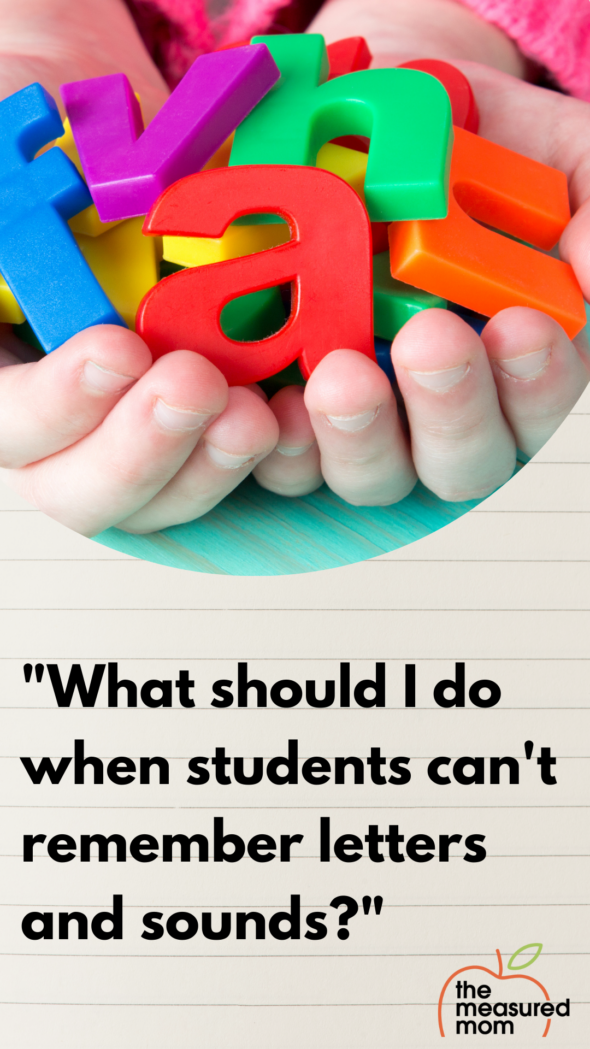
Do you have students who can’t seem to remember letter names and sounds? This post is for you!
Step 1: Examine your current methods.
Make sure that what you’re currently doing aligns with the research (references are at the bottom of this post). Here’s a summary of what we know:
- It may be best to teach letter names and sounds at the same time.
- Teaching letter names and sounds in isolation is effective.
- Research isn’t clear about whether we should teach upper or lowercase letters first, or the best possible order for teaching letters.

- The traditional letter of the week approach is not ideal. One study found that students did better learning 2-4 letters per week.
- We should choose key words that do the best possible job of highlighting the letter’s sound.
- Use multisensory methods to increase engagement, but know that research doesn’t tell us that this is what makes a difference in the actual learning.
- Embedded mnemonics are an effective strategy for teaching letter sounds. (This is where a picture that starts with the letter’s sound is embedded in the letter.)
Step 2: Think about your goal.
Letter names and sounds are a means to an end … this knowledge is useless if students don’t also learn how to blend the sounds to decode words.
If you’re teaching a preschooler, time is on your side. If you’d like, you can focus on letter names and sounds apart from decoding.
If the child is in kindergarten, however, you don’t want to wait until halfway through the year to start reading instruction. You might teach just a few letters and sounds at a time to mastery. Use those letters to teach students to read simple CVC words. Add more letters and sounds as students are ready.
Many teachers have found success with a speech to print approach like Reading Simplified,where letter sounds are taught in the context of words(which, incidentally, can also be used in preschool).
Step 3: Decide how you’ll measure progress.
Make sure you have a weekly method to check your students’ alphabet knowledge. This way you’ll be able to tell if what you’re doing is working, or if you need to switch things up. One thing to try is to use the progress monitoring tools from Acadience or Dibels 8. You can use the Letter Naming Fluency assessment and see if the child can name more letters per minute each week.
Step 4: Directly introduce each letter and its sound using a mnemonic alphabet flash card.
1. Say words that begin with the target letter, and have your student identify the words’ beginning sound.
Say each word after me. (Emphasize the /d/ at the beginning of each word as you say it.) Dinosaur. Duck. Dog. Dip. Door. What sound did you say at the beginning of each word? The sound is /d/. (Make sure you don’t add “uh” to the end of the sound.)
2. Talk about how you form the sound.
Look at what my mouth is doing as I say /d/. Now you try. What is your tongue doing when you say /d/? Put your hand on your throat as you say /d/. Is it a quiet or noisy sound? (noisy)

3. Introduce the letter.
(Hold up a letter dflash card.) This is the letter d. When we see this card, we say, “d spells /d/.” Your turn. (Students: “d spells /d/.”)
4. Teach your student to form the letter using sky-writing and finger-tracing.
To make the letter d, we start in the middle, pull back, around, go all the way up, and down.
Watch me put my hand in the air and write a d in the sky. I start in the middle, pull back, around, go all the way up, and down. Now you try. Put your finger in the air. Start in the middle, pull back, around, go all the way up, and down.
Make a d by moving your finger on the table. Start in the middle, pull back, around, go all the way up, and down. (Other options: sand or salt tray, shaving cream, etc.) Now do the same thing while saying “d spells /d/.” Remember to underline the d when you say /d/. (Practice multiple times.)
Step 5: Choose a method (or a combination) to review the letters and sounds you’ve taught.
Make a plan for how and when you’ll use these interventions. It’s tempting to switch from activity to activity, hoping something will work.
相反,选择1 - 2活动并决定在spe上cific routine you’ll use each day of the week. When the routine is the same, kids can devote their mental energy to learning the letters and sounds rather than the routine.
Stick to your plan, and don’t forget to do a quick assessment at the end of each week. Chart your progress. Alter or switch your intervention if you don’t see a change.
Below you’ll find activities to choose from. Don’t use them all – choose a small combination, decide on a routine, and get started.

MATCH LETTERS ON A COOKIE SHEET
Match magnetic letters to letters on a baking sheet.Heidsongshas a cookie sheet activity bundle on TPT (pictured above).

ALPHABET ARC ROUTINE
Match magnetic letters to letters to an alphabet arc.Learn more at The Daily Alphabet.

ALPHABET FLUENCY GRIDS
Informed Literacy has a wonderful blog post (with videos) about fluency grids and how to use them to reinforce letter names and sounds.Learn more here.
ORTON-GILLINGHAM INSPIRED DAILY REVIEW.
Simply use flash cards or put the letters on a screen as you guide students through a daily visual drill. “P spells /p/.”
PULL & SAY
Put the magnetic letters you’ve taught on a baking sheet. Have students pull down each letter as they say its name, and push it up as they say its sound.
USE AN APP OR VIDEO
Disclaimer: Except for Letter Factory and Starfall, I have not used any of these; however, they have been recommended by other teachers. Try them first before using with students.
- Free digital alphabet arc
- Hairy Letters
- Lively Letters(uses a mnemonic alphabet)
- Phonics with Phonograms
- Watch and sing along to the Leap FrogLetter Factory DVDevery day
- EBLI Island
- Letterland Word Builder
- UFLI Blendable Soundson YouTube
- HeidiSongsalphabet songs with video
- Teach Your Monster to Read
- Lalilo
- Starfall ABCs
- Poio
- Teach Your Monster to Read
- Articulation Station
I hope this post has helped you develop a plan for children struggling with letter names or sounds!

Letter Sound Games & Activities
$24.00
This collection of 30 total activities for beginning, middle, and final sounds will build phoneme isolation skills while helping students master letter sounds!
References
- Geiger, A. (Host). (2019-present). What does the research say about teaching the alphabet? with Dr. Shayne Piasta. [Audio Podcast]. Triple R Teaching.
- Roberts, T.A., Vadasy, P.F., & Sanders, E.A. (2020). Preschool instruction in letter names and sounds: Does contextualized or decontextualized instruction matter? Reading Research Quarterly, 55(4), 573-600.
- Piasta, S. B. (2023). The science of early alphabet instruction: What we do and do not know. In Cabell, S. Q., Neumann, S.B., & Terry, N.P., Eds., Handbook on the science of early literacy (p. 83-94). The Guilford Press.
- Moats. L.C. & Tolman, C.A. (2019). LETRS Volume 1. Voyager Sopris Learning.
- Roberts, T.A., Vasady, P.F., & Sanders, E.A. (2019). Preschoolers’ alphabet learning: Cognitive, teaching sequence, and English proficiency influences. Reading Research Quarterly, 54(3), 413-437.
- Ehri, L.C., Deffner, N.D., and Wilce, L.S. (1984). Pictorial mnemonics for phonics. Journal of Educational Psychology, 76, 880-893.
Free Reading Printables for Pre-K-3rd Grade
Join our email list and get this sample pack of time-saving resources from our membership site! You'll get phonemic awareness, phonics, and reading comprehension resources ... all free!


Kim Oliver
CKLA is aligned to SoR but teaches letter sounds first and then their names several weeks after. I am confused as to how this words in regards to DIBELS 8. Any thoughts?
Anna Geiger
You could repurpose the letter name fluency assessment and use it for letter sounds, for progress monitoring purposes – that’s what I’d do!