

Have you been following along with our series about the Big 5? So far we’ve tackled phonemic awareness and phonics. Now it’s time to discuss the do’s and dont’s forteachingreading fluency.
As I look back on my years as a balanced literacy teacher, I realize that I misunderstood fluency and its place in the big picture.
I was opposed to decodable books because I thought that leveled books, with their predictable language, helped students become fluent readers.
Since my students could “read” those predictable sentences quickly and easily, I thought this was building their fluency.
In contrast, I was troubled when I heard students slooowwlly sound out words in decodable books. I felt that it negatively impacted fluency and comprehension. I felt the same concern thatMargaret Goldberg wrote about in her blog post, The Drudgery (and Beauty) of Decodable texts.
“Sounding out each word took so long that by the time they got to the end of a sentence, students didn’t know what they had read. I worried that I was creating ‘word callers’ (and they weren’t even calling the words very well!)”
As Goldberg studied the science of reading, she learned the same thing that I did: students have to do the hard work of sounding out words to become proficient readers.
Fluencywill not happen right away.
ca时n learn comprehension through whole class read alouds,comprehension of the texts they read themselves will not happen right away.
I can best explain the proper place of fluency through a video excerpt from the Fluency Module of my online course,Teaching Every Reader.
Key takeaways from the video:
- Fluency is the automatic application of decoding and language skills.
- 流利性是理解的桥梁。
It’s easy to go overboard with fluency assessments, or to feel so overwhelmed that you’re not sure where to start.
好消息!评估口服阅读流利性可以快速简单。
What gets confusing is all the acronyms and abbreviations. Let’s get those straight first.
- ORF:Oral reading fluency; it’s a combination of reading rate and accuracy.
- CBM:Curriculum based measurement; it’s the assessment tool that is most commonly used for measuring ORF.
- WCPM:Words correct per minute; it’s how we measure ORF.
To conduct an ORF CBM assessment, listen to a student read aloud from an unpracticed, grade level passage for one minute. Follow along with a copy of the passage and mark any errors.
At the end of the one minute, determine the student’s ORF score by subtracting the number of errors from the total number of words word. The score is expressed as WCPM.
您应该多久评估学生的口头阅读流利程度?这是一个很好的计划:
- Assess first graders’ fluency in the winter and spring.
- For second grade and up, assess oral reading fluency in the fall, winter and spring.
评估后,请确保将学生得分与Jan Hasbrouck和Gerald Tindal汇编的流利度标准进行比较。
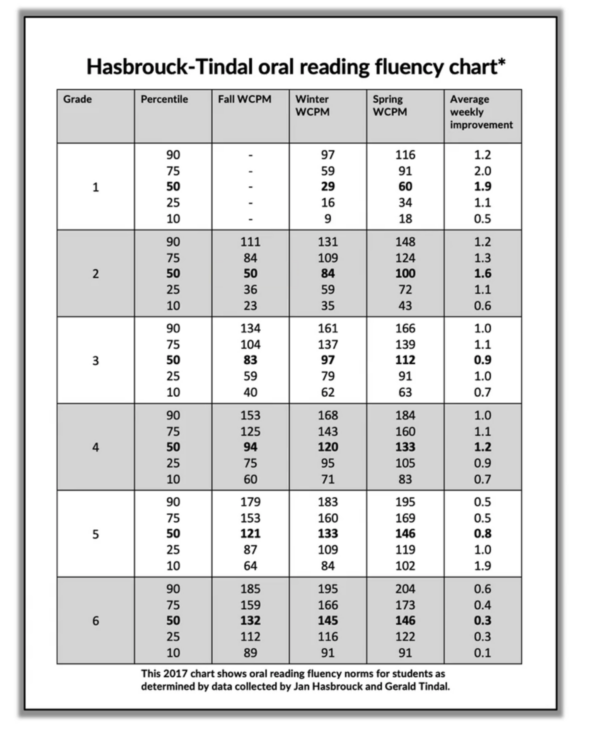
If a child’s fluency is not within ten WCPM of the 50th percentile on the table, you should assess more often and keep track of the child’s progress on a chart.

With all that talk about assessing oral reading fluency, it’s important to remember that we do this to assess only one aspect of fluency.
正如Jan Hasbrouck和Deborah Glaser在手册中写的那样,阅读流畅性,“ORF assessments yield results that can be interpreted and used for making decisions, yet provide only ‘one piece of the puzzle’ when determining overall wellness.”
In fact, there are four key aspects of teaching reading fluency, which I’ve described in the following infographic:
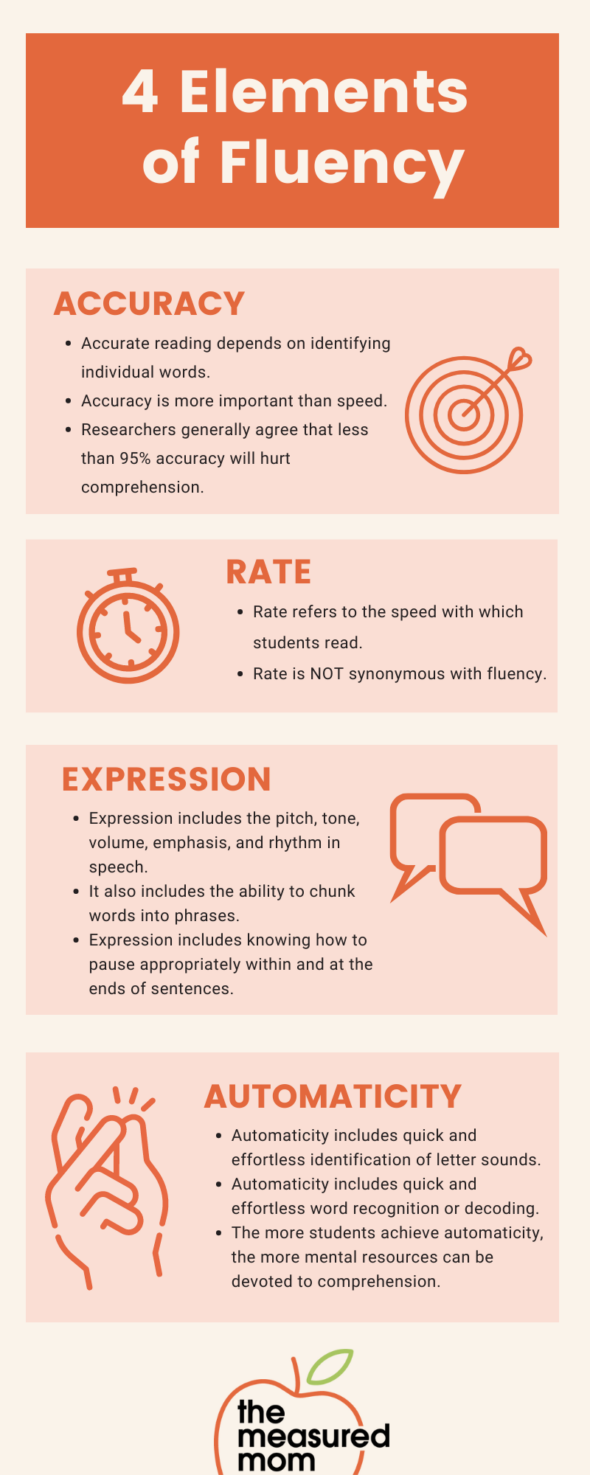
Did you catch the bullets under AUTOMATICITY? Fluency isn’t just about reading words. We need students to be able to quickly identify letters, letter sounds, syllables, and more.
If you’re a student of my course,Teaching Every Reader, you canget a file of fluency drills for all levels in this lesson.
Prosodyis all about to do with reading the way we speak – it’s about reading with phrasing, emotion, and emphasis, and rhythm (even inside our heads).
Teaching students to read with prosody is SUCH an important part of teaching reading fluency.
According to the authors Pamela E. Hook and Sandra D. Jones, in their chapter of the book专家关于阅读干预措施, children must learn to read with expression in order to improve comprehension.
These experts tell us that students must transition from decoding text to constructing meaning by reading with prosody. “Making this connection allows a reader to self-monitor and self-correct, which in turn facilitates the comprehension of text.”
I can speak to this from my own experience. Of our six kids, one stands out as not being particularly interested in reading. (He’d rather shoot baskets, throw a football, or ride his bike any day!) He often reads aloud in a monotone voice, hardly stopping for punctuation.
When I ask him about what he just read, it’s no surprise that he has no idea! In contrast, when he and I read aloud together and I force him to stop and read with expression, his comprehension improves.
Use reader’s theater to build reading fluency
Reader’s theater is an authentic way to get students to reread a text with expression – which builds fluency and improves comprehension.
Reader’s theater combines reading and performing. It requires no costumes or scenery.
You need a copy of the script for each group of students. As the teacher, you’ll assign roles and guide students as they practice reading their scripts. After several days of practice, students can perform their scripts for the class.
I especially love reader’s theater scripts in the form of partner plays!
Partner plays include only two parts, making them ideal for buddy reading and use at centers.
Here’s an audio recording of a partner play I read with my youngest (he just started kindergarten; I taught him to read at home before starting school using a structured literacy approach).
When you get to the end of this blog post, you’re invited to download all three levels of this partner play for FREE!
Fluency is important, but it’s often forgotten in the daily challenge of “fitting it all in.”
听起来很艰难,我建议每天在1 - 3年级中加入流利的练习。
If this sounds tedious, don’t worry. There are countless ways to build fluency!
- Do whole class or small group回声阅读, in which you model how to read a text, and students “echo” you, matching your phrasing as much as possible as they reread the text. This is not a recitation activity; it isreading. Make sure that you gradually increase the amount of text that students echo to prevent them from relying on their memory.
- 做整个小组或小组choral reading.You and your students will read the text simultaneously; it will give them practice developing automaticity and expression.
- For students who need a fluency intervention, usetimed repeated reading.This is when a student reads for one minute and tries to beat their rate and accuracy with successive one-minute readings of the same text. But don’t use this with everyone. According to the authors of the Core Reading Sourcebook, timed repeated reading is best used “as an intervention strategy that is most appropriate for slow but accurate readers who need intense practice to increase their automaticity in reading connected text.”
- Provide fluency drills at centersto give students practice naming letters and letter sounds. More advanced readers should practice reading syllables and single words. If you’re a member of my online course, Teaching Every Reader, you canhead to this lesson to grab a big file of fluency drills.
- Have studentsplay word reading games成对或小组。(我的可编辑阅读游戏的收藏非常适合这一点。)
- Spend a week doing partner plays or reader’s theater(zip to the end of this post to download a free script in three levels!).
- Give students daily time to read text at their independent or instructional level. Phonics lessons are great, but students must practice what they’re learning by reading connected text. I recommend making sure that each student has a bag of decodable texts that s/he can read every day. For students who are ready for leveled books, those should be in the bag as well. Note that I did not say that kids should grab any old book off the shelf and read for fluency practice. Work with your students to choose their books, and hold them accountable. Listen to them read whenever possible.
让我们总结一下!
- 了解流利的作用在学习阅读的全局中。流利性是理解的桥梁。
- DO评估口服阅读流畅性在不同的点the year for first grade and up.
- DON’T仅专注于阅读率。流利度包括准确性,速率,表达和自动化。
- DO提供真实的经验,让学生表达练习阅读。合作伙伴戏剧是我最喜欢的工具!向下滚动以获取免费脚本。
- DON’Tforget to make time for daily fluency building.
CLICK HERE FOR A PRINTABLE VERSION OF THIS BLOG POST

Free partner play in 3 levels
查看本系列的其余部分!
Part 1Part 2Part 3Part 4Part 5
Free Reading Printables for Pre-K-3rd Grade
Join our email list and get this sample pack of time-saving resources from our membership site! You'll get phonemic awareness, phonics, and reading comprehension resources ... all free!


Jennifer Beach
Hi Anna,
What are your thoughts about having early kindergartners reading “memorized text” (like Brown Bear, Brown Bear, What do you See?) to simply practice reading from left to right, wrapping to the next line, turning pages, using pictures as cues, and giving them the sense of successful “reading”, even though they aren’t actually reading words? I use books like this that I have created often at the beginning of the year so they feel like readers, even when they aren’t reading the words. However, as I have been learning about the science of reading, I’m afraid this is more in the form leveled readers. I’m not sure how these fit in, and whether or not they should be a part of my reading instruction. I want my students in books as quickly as possible, but they are not ready to decode yet because we are just learning the letter names and sounds. Help me to know how to proceed. Thanks!
Anna Geiger
So this is a REALLY good question, Jennifer. I think that using the books as you’ve suggested, with memorized text and with kids who aren’t reading yet, is good for teaching concepts of print. The problem comes when we KEEP using these books and tell kids that they are learning to read; when we use books like this with patterns that require them to use the picture, etc. So I think that we can use them in moderation at the very beginning for the purpose of teaching concepts of print. But we have to be careful not to cross the line. It’s a delicate thing, for sure! It looks like you’ve definitely got the right understanding and will be careful how you use them.
盖尔
Oh my goodness! I’ve just download this freebie. I absolutely LOVE it. Such an amazing way to assess reading and the children won’t even know you are assessing them. Thank you Anna, I will definitely purchase the bundle.
Anna Geiger
我很高兴您喜欢它,盖尔!只要您是会员的成员,其中大多数都坐在那里等您。
Heather Ramirez
绝对喜欢和儿子一起阅读样本!!!珍贵,这是我知道的事情,可以帮助需要听到其他孩子阅读的家庭学校孩子(并在可能的时候与他们一起阅读!)。
Anna Geiger
Thank you so much, Heather! :))
艾米
What are your thoughts on repeated readings of decodable poems over the course of a week help improve fluency?
Anna Geiger
To me it sounds like a really good idea. I certainly think kids should reread decodable texts to help with orthographic mapping, and rereading decodable poems will also help with reading with expression.
Magreth Sali
I thank you so so much Anna for sharing this with us . I am so passionate about teaching reading , a subject which is not facilitated at colleges in my country . I would love to do your program to be able to teach ‘ teaching reading ‘ to my colleagues and so help the students.
Anna Geiger
We would love to have you join us in our course, Magreth! The doors to Teaching Every Reader open on October 4.